

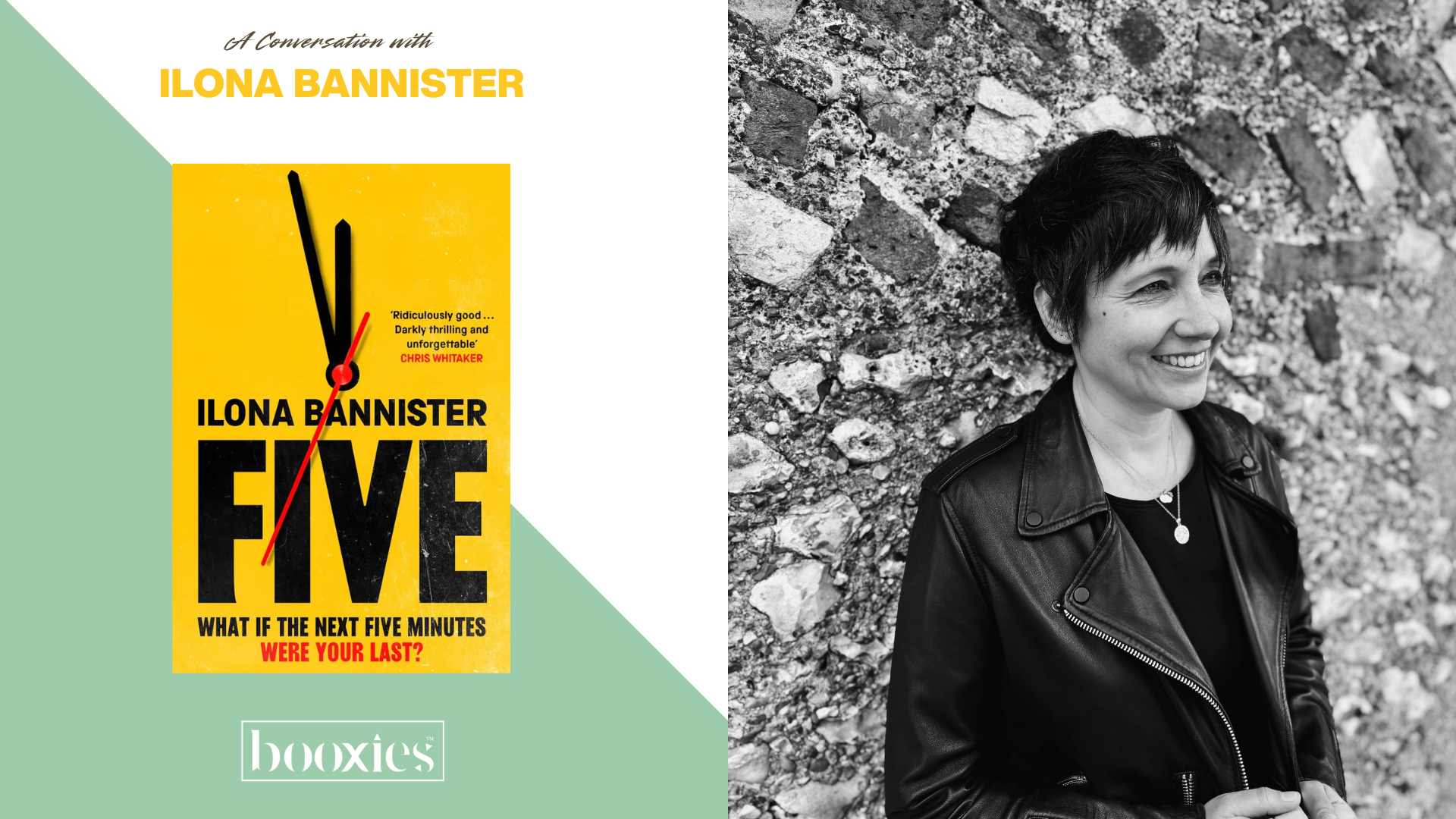
In Conversation With Ilona Bannister
 Five was chosen as our General Fiction subscription pick for June 2026, as you may remember, and our readers absolutely raved about it.
It’s such a privilege to feature you in this Q&A, and we’d like to extend a huge thank you for taking the time to answer our questions.
Your novel follows five strangers in the five minutes before disaster strikes. If you had to describe Five in just five words, what would they be?
[IB] Dark, suspenseful, hopeful, empathetic, unexpected. Or, in a sentence, Let’s be nice to strangers.
Five follows the intertwined lives of five wonderfully complex characters. If you found yourself on a train with just five minutes to spend with one of them, who would you choose, and why?
[IB] I think Emma desperately needs a friend, so if I had five minutes to spend with her, I think I would give her my number and invite her for coffee, and I would tell her to come over sometime and bring Gideon. She would probably say no and be kind of bitchy about it, but then I would squeeze her hand, which she would hate, and I would say, “Take my number anyway, and call me anytime.” She would never call me, but I hope she would at least remember that someone was nice to her, wasn’t judging her, and offered her some kindness. Motherhood can be so isolating, which is something I know well, so I feel like I could actually be a friend to Emma. And I would also like to get into her closet and look at all her beautiful clothes.

From the very first page, readers are left wondering who will survive. Did you know each character's fate from the beginning, or did any of their stories surprise you as you wrote?
[IB] I don’t plan or outline, so I did not know until about 60% of the way through which character would die. I wanted the train platform scenes to feel very urgent, so I tried to write the scenes as though I was standing there too, reacting to the characters, not knowing what they were going to do next. Once I saw which way it was going, however, I then went back to the beginning and reworked each scene so that the crescendo of the action made sense. I had a vague idea of the major themes of each character’s life, but the details of how their lives unfolded and the other people involved with them were indeed a surprise as I went along.
As you've probably noticed from my questions, the number five is woven through every part of the novel. What drew you to that motif, and what does it represent for you?
[IB] We use the phrase “five minutes,” all the time: “I’ll be there in five,” “it only takes five minutes,” “it’s just five minutes away.” It’s our universal shorthand for something being quick or brief. But if you actually stood still for five minutes, it can feel like a surprisingly long time. So I thought it was interesting to see whether a whole story could happen in that amount of time. I am also interested in crisis moments, and the idea that in between Before and After, there is the last five minutes, when things are still the same, but you can see they are about to be changed forever. I I thought that the urgency and mundanity of five minutes, a sliver of time we are so familiar with but which is also enough time to change our lives forever, was an interesting space for a story. Five people and five minutes seemed a natural fit, and figuring out everything that could happen to them in that time was challenging, but fun to write.
One of the things I loved most about this book is the reminder that everyone we pass each day is carrying a story we know nothing about. Has writing this novel changed the way you see, or interact with, the strangers around you?
[IB] I have always had deep empathy for what it means to be an outsider or a stranger in an unfamiliar place, and I have always been drawn to stories about lives lived in the periphery, outside of the mainstream. All of the characters in Five are struggling in some way with trying to fit into their social groups or communities, but not quite being able to. I grew up in the Ukrainian immigrant community in New York City as the child and grandchild of refugees. I went to university in Nashville, Tennessee, a thousand miles and a world away from my life as a New Yorker and it was interesting, but also difficult to fit in. I became an immigration lawyer, and then I migrated from the US to the UK, where I have lived, worked, and brought up my family for the past 20 years, in a country I consider my home, but where I will always be a foreigner culturally. I have explored outsider status in all of my books because I learned over time, both from my immigrant upbringing and from practicing immigration law, that the most interesting and moving stories are not in the centre, but on the edges and in the places where we don’t look. That is why I am always watching people, observing them, and wondering about their lives. People are fascinating in what they show you about themselves, and what they choose to keep hidden.
After spending so much time immersed in heavy themes of life, death and morality - what kind of books do you reach for when you need a break? Do you have a favourite literary palate cleanser?
[IB] I love the essays of Samantha Irby. She’s author of the essay collections, We Are Never Meeting In Real Life, Meaty, Quietly Hostile, and Wow, No Thank You. She writes about difficult themes - health, trauma, racism - but she is hilariously, uproariously funny. And being funny on the page is so incredibly difficult. I also love her because her pop culture references are perfect for Gen X readers, like me, and I really appreciate how she uses them. She is personal, thoughtful, vulnerable, and truly lovable, so her essays are a hopeful and funny break. I think she’s a genius.
And on a lighter note - what's your writing companion of choice? A comforting cup of tea, coffee to keep the words flowing, or a nice glass of something once you've finished a chapter?
[IB] I am a New Yorker so I was born drinking coffee. My best writing time is as soon as I get up, usually 5:30am. I have an American style drip coffee maker with a glass pot and I can set the timer so that my coffee is ready and waiting when I get up. It is truly my favourite thing, both for writing and life in general.
You mention in your acknowledgements that you spent a lot of time researching by travelling on trains. What made you decide to settle on a train station? After all that time exploring stations, what makes a memorable one?
[IB] I am interested in mundane public places which we often take for granted. We have an implicit social contract with each other about appropriate behaviour in supermarkets, post offices, train stations, bus stops, so I think these kinds of places are great settings for stories. They are universally familiar, and it’s fun to think of all of the things that can happen there between people. The New York City subway is part of my earliest childhood experiences, and in England, we use trains all the time. So trains and train stations have always been part of my life, like they are for many people around the world. We don’t really notice train stations, because we’re thinking about where we’re going, looking at our phones, trying to get somewhere on time, but they are inherently extremely dangerous spaces. Yet we all stand there, waiting for these giant, hulking, speeding, electrified vehicles to arrive, and we trust that the strangers around us will be sensible and safe. I just thought it was the perfect place to set a suspenseful story.
I think the great stations are the ones which give you a sense of vast possibility because of soaring ceilings or they reference the past golden age of trains mixed with modern architecture, so my favourites are London Waterloo, the old brick sections of London Bridge, Glasgow, and of course, I have to say Grand Central in Manhattan.
Five by Ilona Bannister is available to purchase on our website, add it to a Build Your Own Booxie to make the perfect gift for someone lucky!


Leave a comment
This site is protected by hCaptcha and the hCaptcha Privacy Policy and Terms of Service apply.